
Screen does not fail on a schedule so much as it fails on an exposure budget. Two identical cages built the same year in the same subdivision can be three years apart in condition purely because one faces west into unshaded afternoon sun and the other sits behind an oak.
The honest ranges for Tampa
| Item | Detail |
|---|---|
| Standard fiberglass, shaded or north-facing | 7 – 10 yrs |
| Standard fiberglass, typical Tampa lot | 5 – 8 yrs |
| Standard fiberglass, unshaded south or west wall | 4 – 6 yrs |
| Standard fiberglass, waterfront with salt exposure | 4 – 6 yrs |
| Pet-resistant polyester | 8 – 12 yrs |
| Florida Glass | 10+ yrs |
Why Florida is harder on screen than almost anywhere
Three factors compound. UV intensity is among the highest in the continental United States and it runs most of the year rather than three months of it. Humidity keeps everything in a state of slow degradation. And near the coast, salt attacks the aluminum hardware rather than the mesh, which means the frame fails around perfectly good screen.
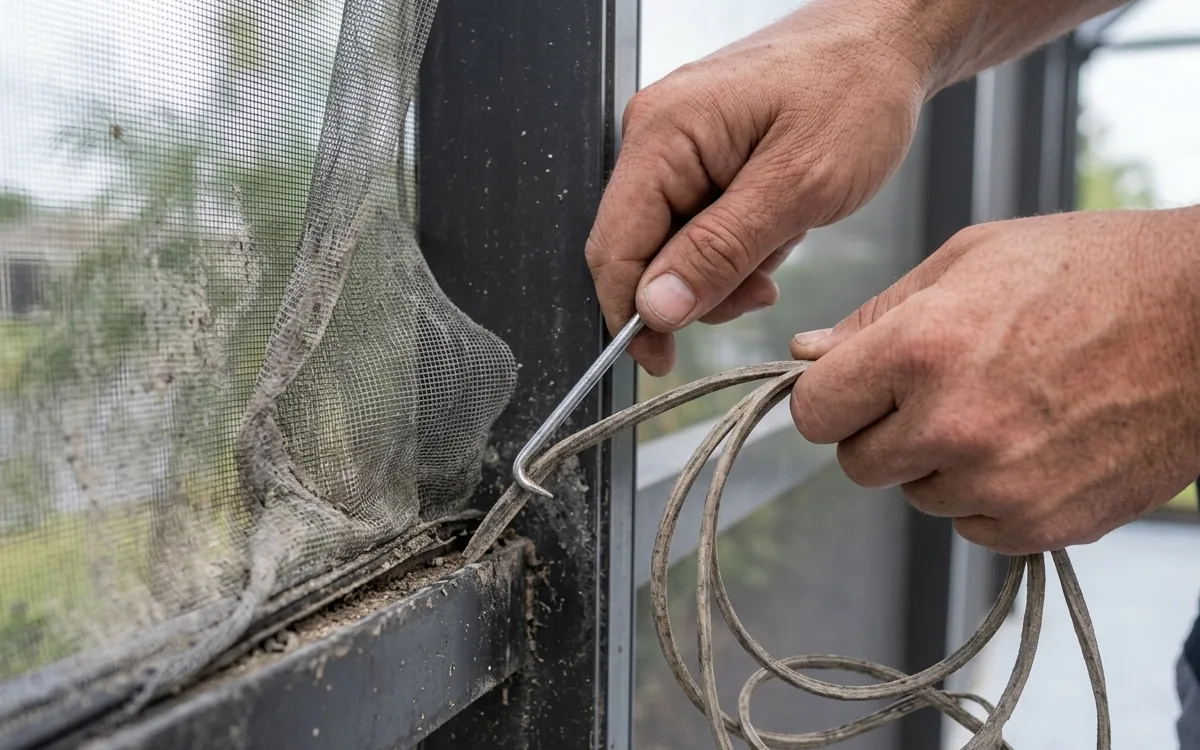
That last point is worth sitting with. Inland, in Brandon or Riverview, mesh is nearly always what fails first. On the water in Apollo Beach or South Tampa, it is frequently fasteners and anchors, and rescreening without addressing them accomplishes very little.
Six signs it is time
- Colour has gone chalky grey. New charcoal mesh is genuinely dark. When it turns pale and dusty-looking, the coating has degraded and the fibreglass core is exposed to UV directly.
- It tears when you press it. Push gently with a fingertip. Sound mesh flexes and returns. Degraded mesh splits. This is the clearest single test.
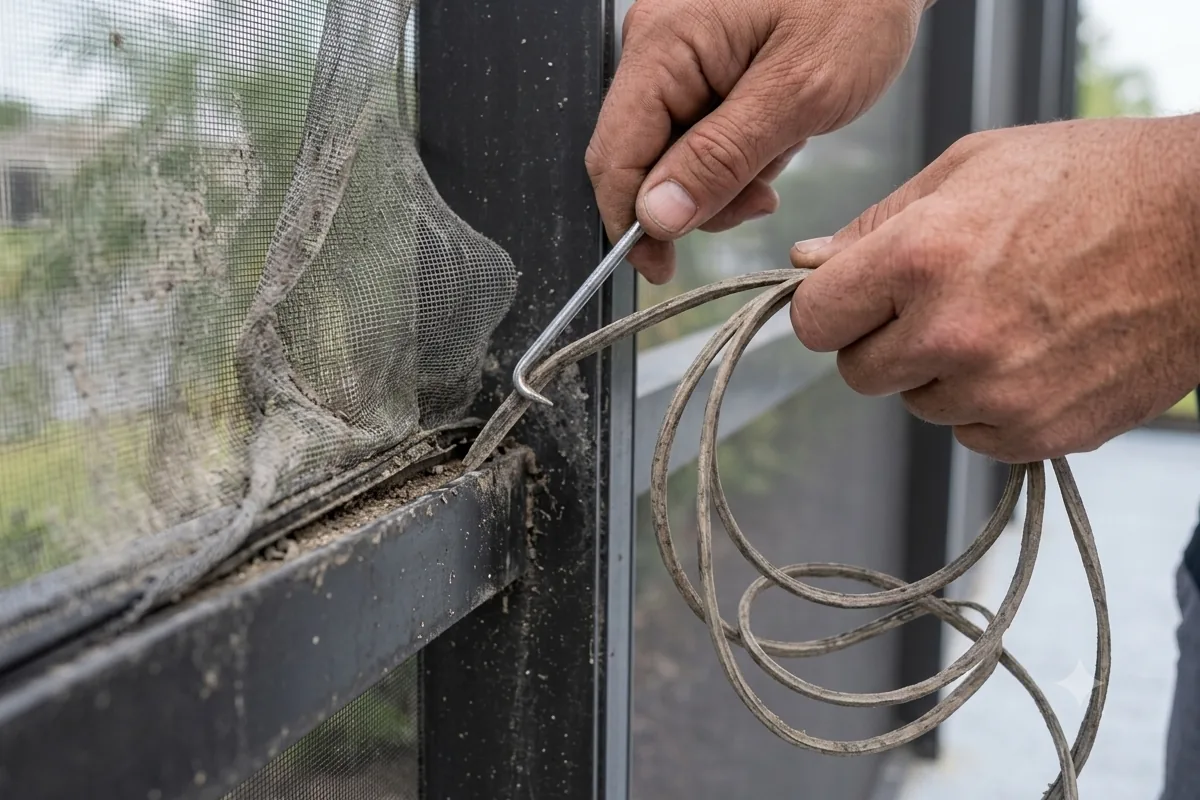
- Panels sag when pushed. If a panel deflects and stays deflected, tension is gone. Often a spline problem rather than a mesh problem, but either way it needs work.
- Spline is visible above the channel. Dried spline shrinks and backs out. Once you can see it sitting proud of the frame, it has lost its grip.
- Fine debris comes through. Degraded mesh opens up at the weave. If leaf fragments and grit are reaching the pool, the openings have grown.
- You are getting bitten inside. Sometimes a mesh grade issue rather than an age issue, but on old screen it is usually both.
Can you extend the life of your screen?
Somewhat, and less than the internet suggests. Rinsing mesh with plain water a couple of times a year removes salt and grit that abrade the fibres, which genuinely helps on waterfront property. Trimming branches that overhang the cage prevents impact damage. Keeping furniture from resting against panels prevents localised stretching.
What does not work: pressure washing, which drives water through the weave and can blow panels out; bleach or harsh cleaners, which strip the protective coating and accelerate UV damage; and any sprayed-on coating or sealant marketed as extending screen life, none of which we have seen make a measurable difference.
Replace everything or just the failed walls?
If the sun-facing walls have failed and the shaded ones are still sound, doing the failed walls now is legitimate and saves money. Accept that new mesh looks noticeably darker beside faded panels for the first year or two. If every panel fails the fingertip test, do the whole cage — you will otherwise be paying mobilisation twice within two years.
We check spline and frame condition free as part of any pool cage rescreening estimate, and if the answer is that you have three good years left, we will tell you that.