
Service · Tampa, FL
Pet-Resistant Screen Installation in Tampa
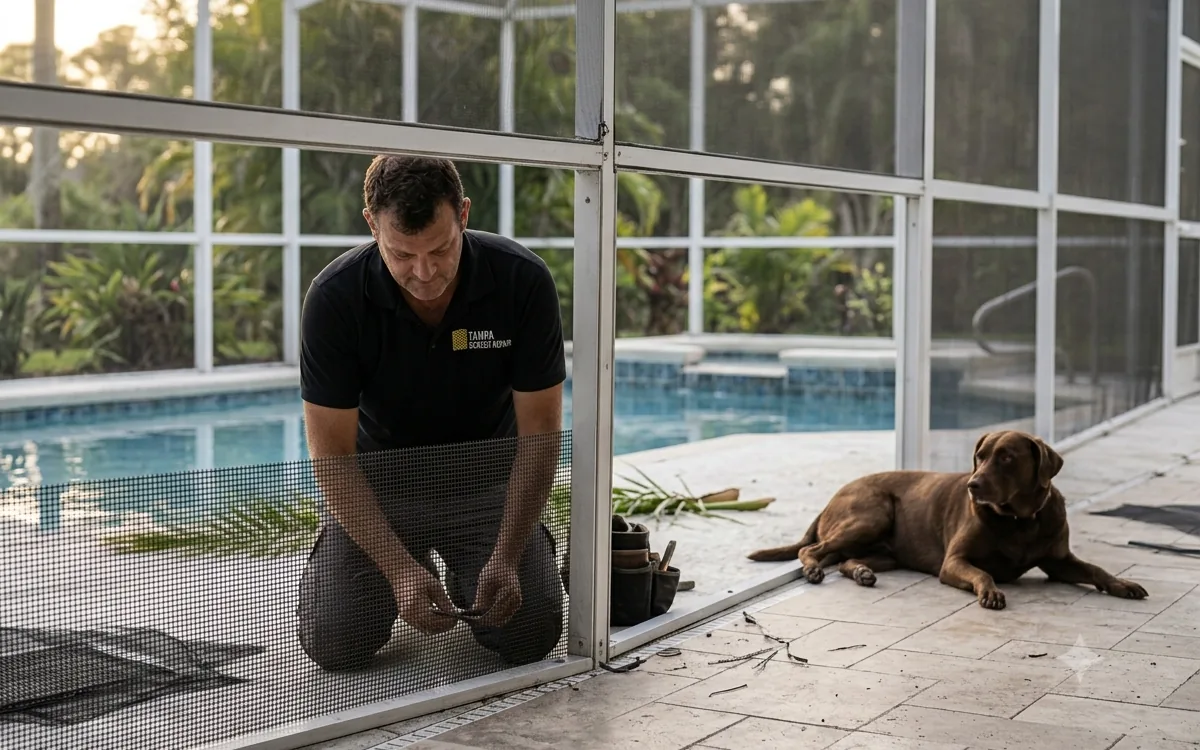
Vinyl-coated polyester mesh that stands up to dogs and cats. Best installed in the lower panels and door zones where the claws actually land.
Screen that survives dogs and cats
Standard fiberglass insect screen is roughly as strong as it needs to be to stop a mosquito, which is to say not strong at all. A medium dog leaning on it will stretch it. A cat using it as a scratching post will shred it in a week. Pet-resistant screen is a different product entirely: vinyl-coated polyester strands, considerably thicker, woven tighter, and rated at approximately seven times the tear strength of standard mesh.
The important thing to understand is where to put it. Almost every pet owner who calls us assumes they need the entire enclosure in pet mesh. Almost none of them do. Pet damage happens in a predictable band — the bottom two or three feet of panels, and the area immediately around the door — because that is where paws, claws and shoulders make contact. Screening only that band in pet mesh and leaving standard mesh above typically cuts the upgrade cost by well over half while covering essentially all the actual risk.
How pet mesh differs
- Roughly 7× tear strength — vinyl-coated polyester rather than coated fiberglass.
- 8 to 12 year lifespan — noticeably longer than the 5 to 8 you get from standard mesh in Tampa.
- Slightly darker panel — thicker strands cut a little more light and a little more view.
- Marginally reduced airflow — real but small; most people do not notice it.
- Higher cost per square foot — which is exactly why partial installation makes sense.
- Not indestructible — a determined large dog at full speed can still get through.
What pet screen installation costs
Pet mesh is priced as an upgrade over standard rescreening, generally $1.75 to $3.25 per square foot on top of the base per-panel price. In practice a lower-row pet mesh install on a typical lanai adds $120 to $340 to the job. Doing an entire pool cage in pet mesh can add $600 to $1,400, which is why we so rarely recommend it.
| Job | Typical range | What moves the price |
|---|---|---|
| Lower rows, typical lanai | +$120 – $340 | Number and size of panels |
| Lower rows, pool cage | +$220 – $520 | Panel count and height |
| Door panel only | +$45 – $95 | Door size |
| Full lanai in pet mesh | +$380 – $780 | Total openings |
| Full pool cage in pet mesh | +$600 – $1,400 | Panel count |
| Pet mesh + kick plate combo | Quoted on site | Coverage strategy |
Pet mesh versus a kick plate
For very large or very determined dogs, pet mesh alone is sometimes not the answer. A solid kick plate — Florida Glass or an aluminum panel — on the bottom eighteen to twenty-four inches removes screen from the impact zone entirely. It costs about the same as pet mesh, blocks the view at deck level, and is genuinely dog-proof rather than dog-resistant. We will talk through the trade-off on site based on your specific animal.
Cats specifically
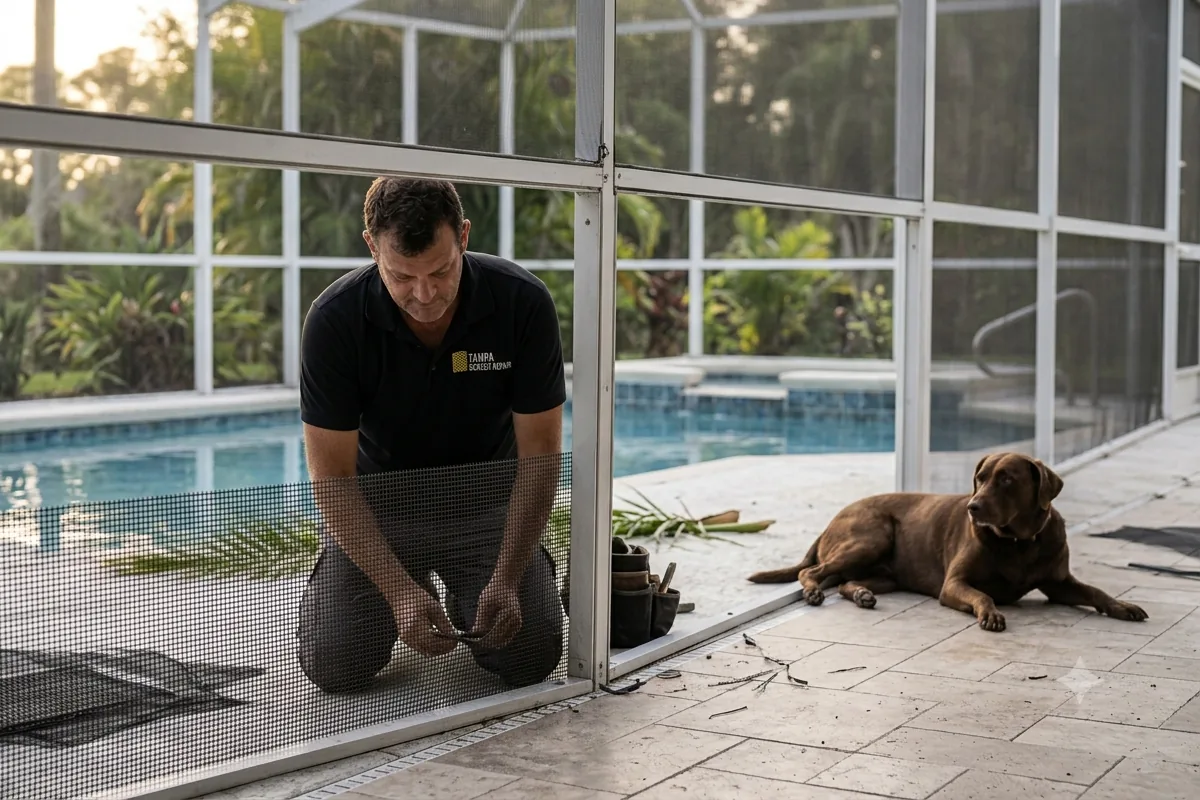
Cats are a different problem from dogs. The damage is claw-driven and vertical rather than impact-driven and low, so it can appear anywhere a cat can reach — which on a screen enclosure is higher than you would think. For serious scratchers we usually recommend pet mesh higher up the panel than we would for a dog, or the full panel where the cat has a favourite spot.
Combining with other work
Pet mesh is almost always installed as part of a pool cage rescreen or lanai screen repair, since the panels are coming out anyway. If your screen door is also taking pet abuse, that is the moment to upgrade it to a heavier frame with pet mesh in one visit.
Where we install pet screen
Everywhere in our service area, with heavy demand in the family neighbourhoods of Riverview, Brandon, Valrico, Wesley Chapel and Lithia.
Questions
Pet-Resistant Screen Installation FAQs
It stops normal scratching, leaning and paw pressure, which is what causes the overwhelming majority of pet damage. Pet mesh is rated at roughly seven times the tear strength of standard fiberglass. A determined large dog running at full speed can still get through it, which is why we sometimes recommend a solid kick plate instead for those animals.
It runs $1.75 to $3.25 per square foot above the standard rescreening price. On a typical lanai, doing the lower rows adds $120 to $340. Doing an entire pool cage in pet mesh adds $600 to $1,400, which is why we usually recommend partial installation instead.
Almost never. Pet damage happens in a predictable band: the bottom two to three feet of panels and the area around the door, where paws and shoulders make contact. Screening only that band and leaving standard mesh above covers essentially all the real risk at less than half the cost of a full install.
Slightly. The strands are thicker, so a pet mesh panel is a little darker and cuts marginally more light and view than standard mesh. Where pet mesh sits directly below standard mesh you can see the difference if you look for it, though most homeowners stop noticing within a week.
Eight to twelve years, compared with five to eight for standard fiberglass in the Tampa climate. The vinyl coating on the polyester strands holds up better against UV as well as against claws, so you get durability on two fronts. That longer life offsets a meaningful part of the higher up-front cost.
Yes, but positioned differently. Cat damage is claw-driven and vertical rather than low-impact, so it appears wherever the cat can reach, which is higher than most people expect. For a serious scratcher we recommend pet mesh higher up the panel than we would for a dog, or the whole panel at a favourite spot.
Marginally. The weave is tighter and the strands thicker, so there is a real reduction, but it is small enough that most people do not notice it on a lanai or pool cage. If maximum breeze matters to you, keeping standard mesh on the upper panels preserves most of the airflow while the lower rows take the abuse.
A kick plate is a solid panel — Florida Glass or aluminum — on the bottom eighteen to twenty-four inches of an enclosure, replacing screen entirely in the impact zone. It costs about the same as pet mesh and is genuinely dog-proof rather than dog-resistant. The trade-off is that it blocks the view at deck level.
Yes, and it is often the highest-value single upgrade, because the door is where most pets try to get through. For large dogs we usually pair pet mesh with a heavier door frame, since a standard residential slider will rack and bend under repeated pushing regardless of how strong the mesh is.
Yes. We can replace specific panels with pet mesh and leave the rest of the enclosure alone. That is the most common way we do it, and it works particularly well when your existing mesh is still in good condition and only the lower rows have been damaged.
Related
Other screen work we do
Get a price for your pet-resistant screen installation
Free on-site estimate with a flat written price before we start. Call or send photos and we will tell you what it costs.
Mon–Sat 7:00am–7:00pm · Licensed & insured · Serving Tampa, Brandon, Riverview & Wesley Chapel