
Standard fiberglass insect screen is engineered to stop a mosquito. That is the entire specification. It is not designed to resist a forty-pound animal leaning on it, and it does not.
What pet screen actually is
Vinyl-coated polyester rather than coated fiberglass. Thicker strands, tighter weave, and roughly seven times the tear strength. The vinyl coating also resists UV better than standard mesh coating, which is why the lifespan runs eight to twelve years against five to eight.
| Item | Detail |
|---|---|
| Tear strength | ~7× standard fiberglass |
| Lifespan in Tampa | 8 – 12 yrs vs 5 – 8 |
| Upgrade cost | +$1.75 – $3.25 per sq ft |
| Airflow | Marginally reduced |
| Appearance | Slightly darker panel |
| Stops a charging large dog | No |
The mistake almost everyone makes
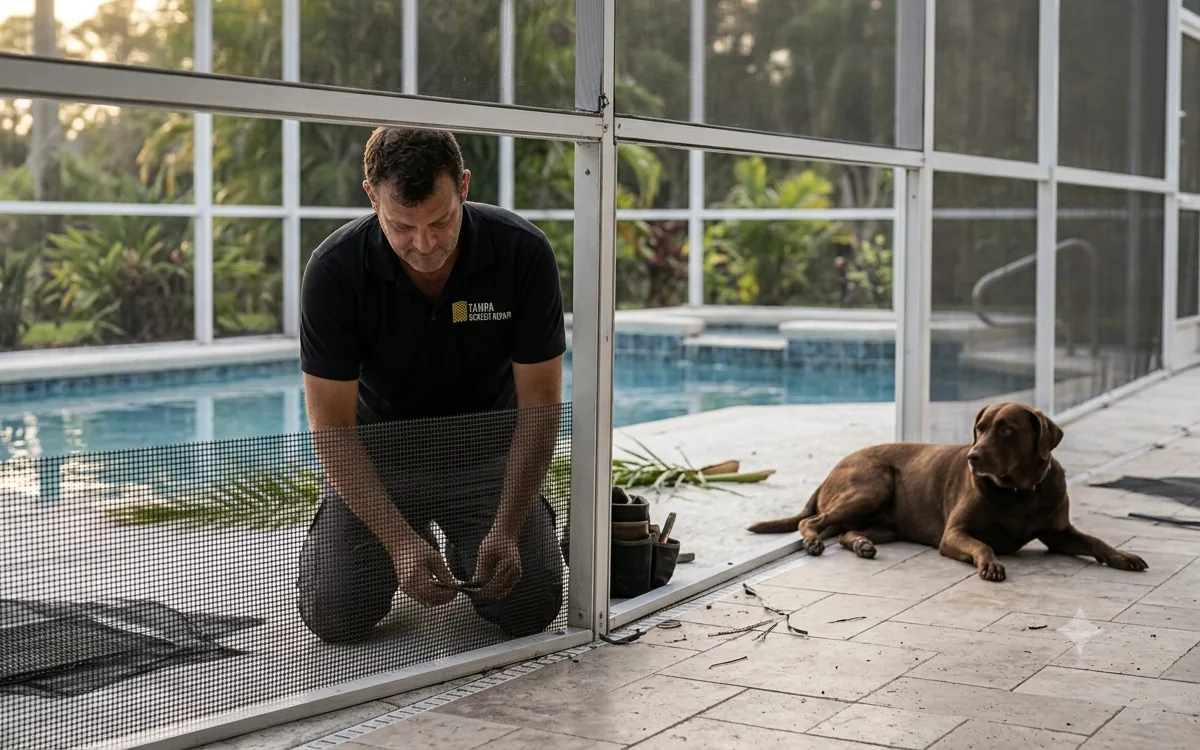
Homeowners call and ask for their enclosure to be done in pet screen. What they need is for part of it to be done in pet screen.
Pet damage is not randomly distributed. It occurs in the bottom two to three feet of panels and in the area immediately around the door, because that is where paws, claws and shoulders make contact. Above roughly waist height, a dog simply does not touch the screen. Doing the lower rows and the door in pet mesh and leaving standard mesh above typically cuts the upgrade cost by well over half and covers essentially all the real risk.
On a typical lanai that means $120 to $340 rather than $380 to $780. On a pool cage it means $220 to $520 rather than $600 to $1,400. Same protection, substantially smaller invoice.
When pet mesh is not the answer
For a genuinely large and determined dog that treats the enclosure as an obstacle rather than a boundary, pet mesh will slow it down and not much more. In that situation a solid kick plate — Florida Glass or an aluminum panel across the bottom eighteen to twenty-four inches — removes screen from the impact zone entirely. It costs about the same as pet mesh, is genuinely dog-proof rather than dog-resistant, and the trade-off is that it blocks the view at deck level.
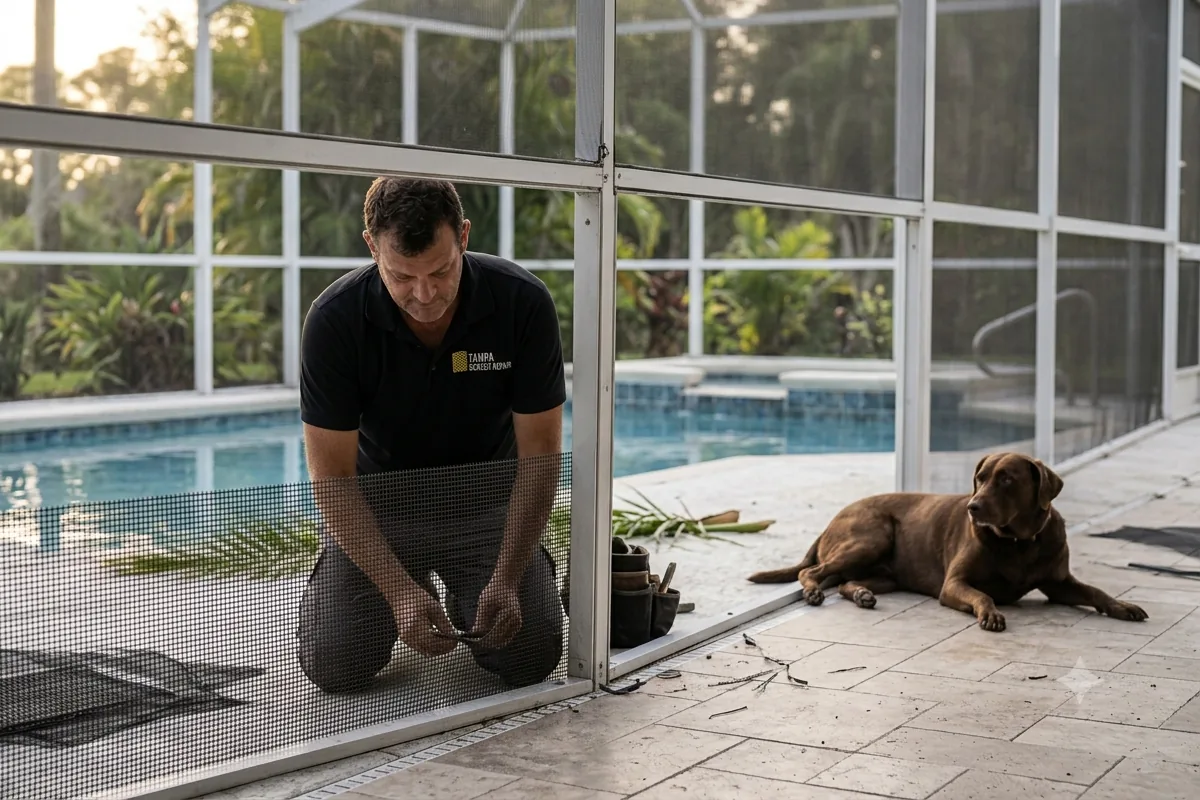
The other case where we steer people away is a dog that is destroying the screen door rather than the panels. Pet mesh on a standard residential slider does not help much, because what fails is the door frame racking under repeated pushing. That needs a heavier door, and the mesh is secondary.
Does the appearance difference matter?
Slightly, and less than people fear. Pet mesh strands are thicker, so a pet-mesh panel is a little darker and cuts marginally more light and view. Where pet mesh sits directly below standard mesh you can see the transition if you look for it. In practice most homeowners stop noticing within about a week, and the alternative — a torn panel — is considerably more visible.
The economics over ten years
This is where partial pet mesh becomes clearly correct rather than merely cheaper. Standard mesh on the lower rows of a dog household will be damaged and replaced repeatedly, possibly several times inside the period a pet mesh panel would have lasted. Each of those replacements carries a mobilisation cost. Pet mesh on the lower rows is typically cheaper over ten years than standard mesh on the lower rows, before you account for the aggravation.
Upper panels are the reverse. Nothing is touching them, so the longer lifespan of pet mesh buys you very little there and you have paid a premium for it. Full pricing is on our pet-resistant screen installation page.