
We get called out to fix other companies’ rescreens fairly often, and the pattern is consistent enough to be predictable. Mesh itself does not stretch appreciably in its first year. If a fresh rescreen has gone slack, something was done wrong during installation, and it is almost always one of four things.
1. Reused spline
Spline is the flexible cord that wedges screen into the frame channel. It is the entire mechanism holding your mesh under tension, and it is the cheapest component of the job by a wide margin.
Old spline that has been in a Florida frame for six years is dried, shrunken and compressed. Pull it out and roll it back in and it no longer fills the channel or grips the mesh. The panel will look fine on the day and be visibly slack within a season. Reusing spline saves a couple of dollars per panel and perhaps ten minutes across a whole cage, which tells you it is about speed rather than materials cost.
How to check: look at the spline in the channel. New spline sits flush and full, tight against the mesh with no visible gaps. Old spline sits low, looks glazed rather than matte, and often has a gap along one edge. If you can see daylight beside the spline, it is not doing its job.
2. Mesh grain run the wrong way
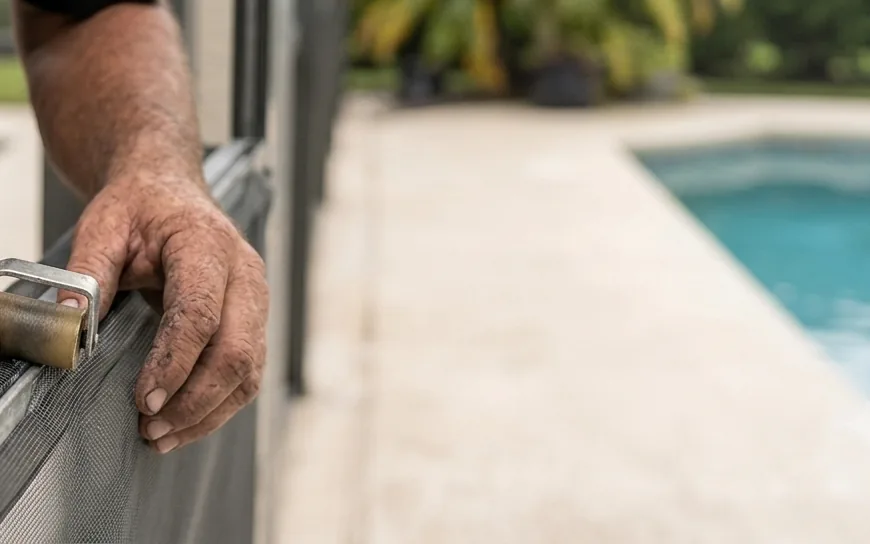
Screen mesh is not isotropic. It has a warp direction and a fill direction, and it resists stretch far better along one axis than the other. Run the wrong axis across the long dimension of a tall panel and it will bag out in the middle within months no matter how well it was tensioned on day one.
This is the shortcut that gets taken to reduce cutting waste. Rolling mesh the "wrong" way across a set of panels can save a meaningful amount of material on an awkward cage. It is invisible on completion and obvious eight months later.
3. Tension applied per wall instead of per panel
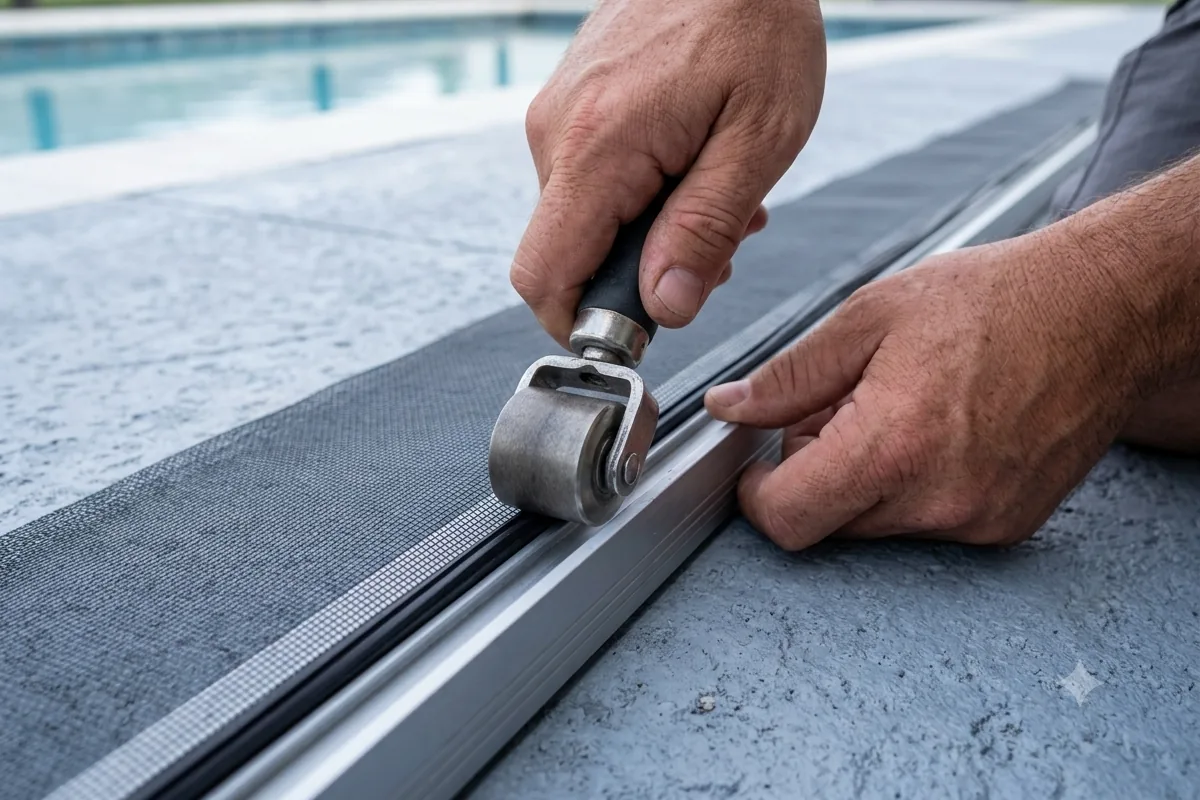
The correct method is to tension each opening individually, working the mesh into the channel progressively so the panel finishes flat and even. The fast method is to pull a whole wall tight, spline it quickly, and move on.
Wall-tensioning produces panels that are over-tight at the ends and slack in the middle, and it puts uneven load into the frame. On a cage with any existing hardware weakness it can pull fasteners loose. You can spot it by comparing panels along one wall: if tension varies noticeably between adjacent openings, they were not done individually.
4. Frame problems that were never mentioned
This is the most common of the four in the older parts of Tampa. A channel that has corroded out, a fastener that no longer bites, a corner joint that has opened — none of those will hold tension regardless of how well the mesh is installed. Rescreening over them produces a panel that fails again in the same place.
That is the diagnostic: if the same specific opening keeps failing while its neighbours hold, it is not a mesh problem. Roughly one in four cages we inspect in Carrollwood and Temple Terrace needs some frame work before mesh goes in, and a rescreen quote that never mentions the frame in those neighbourhoods is worth questioning.
What to ask before you hire anyone
- Is the spline new? There is one correct answer.
- How do you determine mesh direction? A competent installer will explain warp and fill without hesitating.
- Do you tension per panel or per wall? Per panel.
- What did you find on the frame? If the answer is that they did not look, that is your answer.
- Are roof panels included? Not a sag question, but the other place cheap quotes hide.
If it has already happened
Go back to whoever did the work first — most reputable companies warranty workmanship for at least a year and sagging inside that window is squarely a workmanship failure. If they will not stand behind it, we will assess it and tell you which of the four causes it was, in writing, whether or not you hire us to redo it. Our own rescreening work carries a two-year workmanship warranty for exactly this reason.